
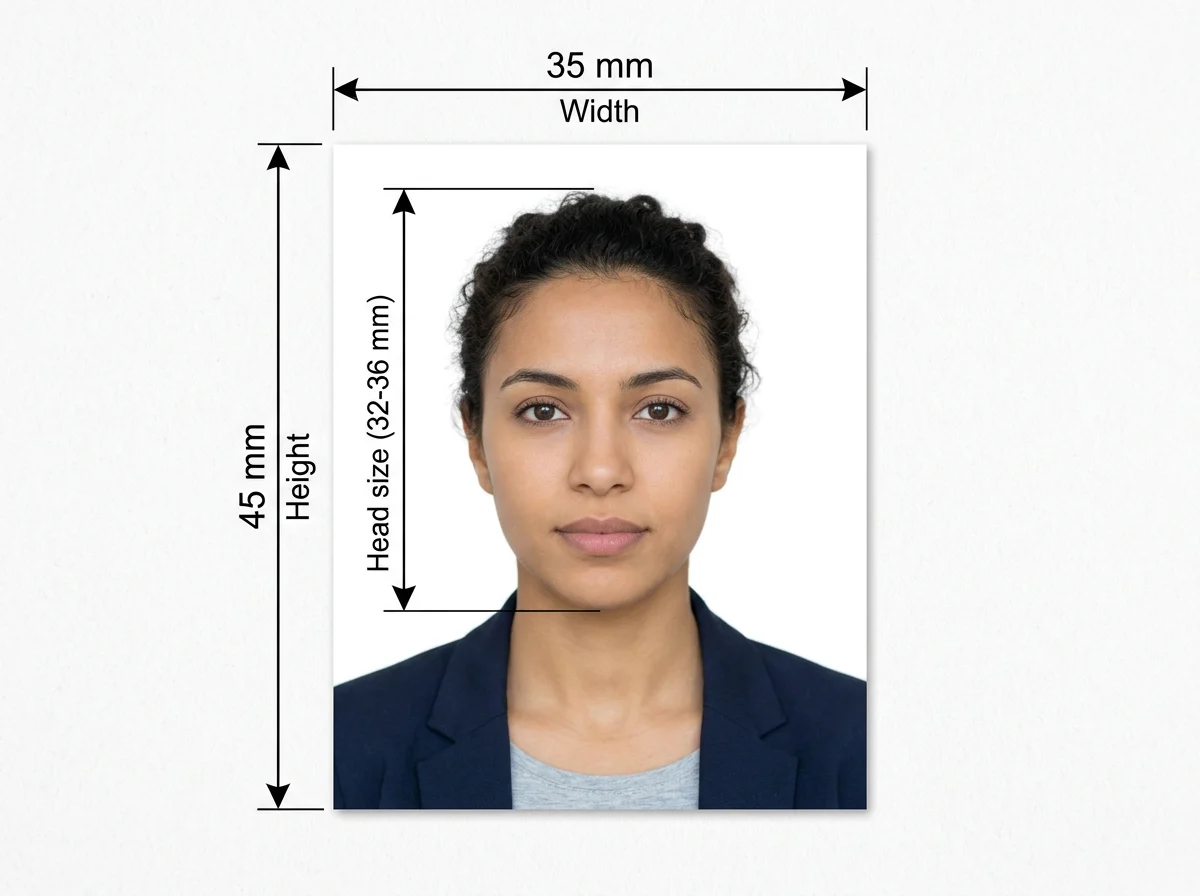
Anyone applying for travel authorization to this nation must submit an image meeting the strict Morocco visa photo requirements.
You must provide a recent color picture featuring a purely plain white background.
The exact Morocco visa photo size required by immigration authorities is 35 mm by 45 mm.
Whether you require a traditional embassy stamp or the digital Morocco eVisa, a compliant passport photo Morocco format is mandatory.
Failing to meet these specific dimensions, background rules, or facial expression guidelines will result in an immediate rejection of your application.
Standard Morocco Visa Photo Size and Dimensions
Getting the physical dimensions right is the most critical step in the application process.
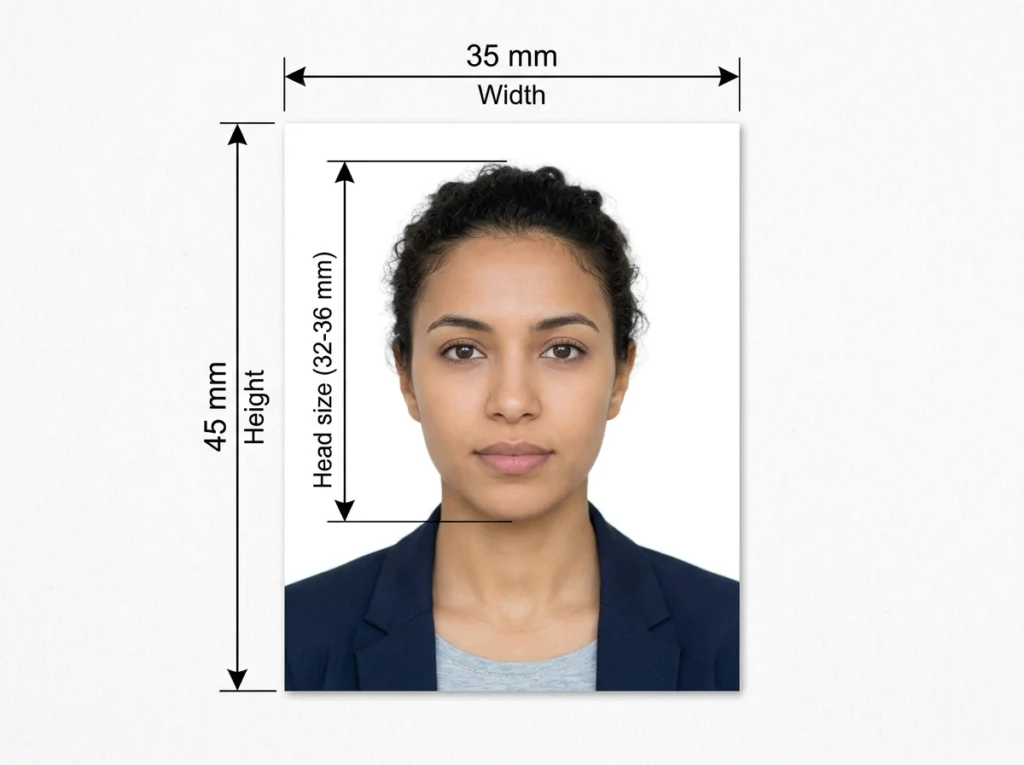
The Moroccan government mandates that submitted photographs measure exactly 35 mm in width and 45 mm in height.
Your head must measure between 32 mm and 36 mm from the bottom of your chin to the crown of your head.
There must be a visible gap of 2 mm to 4 mm between the top of your hair and the upper edge of the photo frame.
Your shoulders and upper chest must remain clearly visible at the bottom of the picture.
These precise specifications align with the international biometric standards enforced by the Morocco Ministry of Foreign Affairs.
NOTE: Submitting an incorrectly sized picture is the primary reason for visa processing delays.
|
Specification |
Requirement |
|---|---|
|
Morocco visa photo size |
35 mm x 45 mm |
|
Head Height |
32 mm to 36 mm |
|
Background Color |
Plain white or very light gray |
|
Recency |
Taken within the last 6 months |
|
Expression |
Neutral, mouth closed, eyes entirely open |
Background Color and Lighting Requirements
The background of your document photo must be completely plain and light-colored.
A pure white or very light gray backdrop is legally necessary for all submissions.
No textures, patterns, furniture, or secondary colors are permitted behind the applicant.
The lighting setup must perfectly illuminate your face evenly from all sides.
Shadows appearing on your face, neck, or the background wall will invalidate the entire image.
Overexposure or heavy flash reflections appearing on your skin are unacceptable.
Red-eye effects from harsh camera flashes will cause an immediate rejection of the photograph.
Face Position and Expression Rules
Applicants must position their head squarely facing the camera lens.
Profile shots, tilted angles, and looking over your shoulder are strictly prohibited.
You must maintain a completely neutral facial expression throughout the photograph.
Your mouth must remain closed without any visible teeth.
Smiling, frowning, or raising your eyebrows will result in a non-compliant image.
Both of your eyes must be fully open and clearly visible to the camera sensor.
Your hair should be tucked away securely so it does not obscure your cheeks or eyebrows.
NOTE: Infants and young children have slightly more lenient expression rules, but they still must face the camera directly.
What is NOT Allowed in the Photo
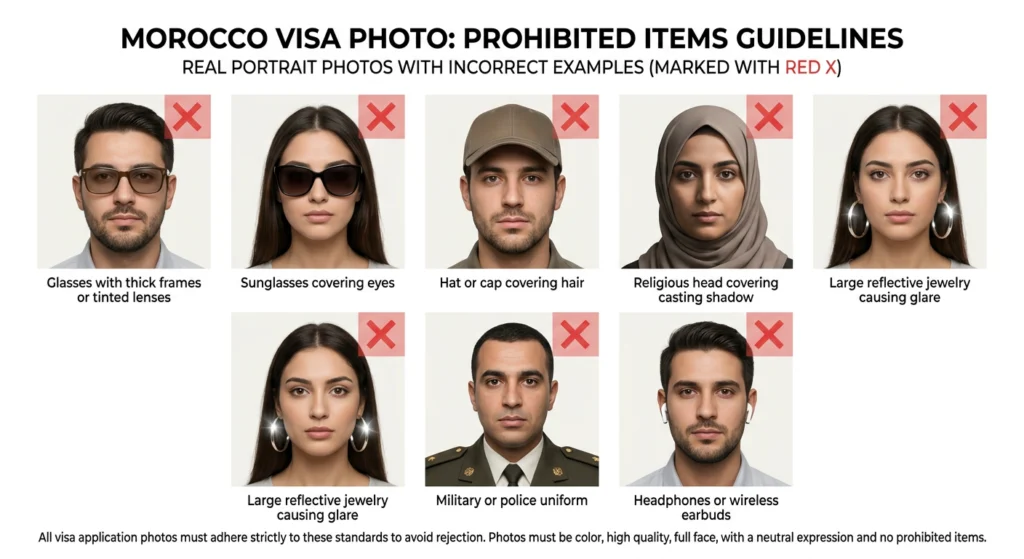
There are strict legal guidelines regarding accessories and clothing in your submission.
To ensure your Morocco visa photo requirements are fully satisfied, avoid the following items.
- Prescription glasses with thick frames or tinted lenses that hide your eyes.
- Sunglasses, transition lenses, and novelty eyewear of any kind.
- Headwear such as hats, caps, or beanies that cover your hair.
- Religious head coverings that cast shadows on your face or obscure your facial features.
- Large, flashy jewelry that reflects light directly into the camera lens.
- Uniforms of any type, including military or law enforcement attire.
- Headphones, wireless earbuds, or hands-free communication devices.
If you must wear a head covering for religious purposes, it must be plain and reveal your face from the bottom of the chin to the top of the forehead.
Digital Photo Requirements for eVisa
The authorities introduced an online travel authorization system in July 2022.
If you meet the eligibility criteria, you will upload your image directly to the official eVisa platform.
The digital passport photo Morocco file must be uploaded strictly as a JPEG or JPG file format.
The file size limitation typically ranges between 50 KB and 2 MB to ensure high resolution.
Your digital image cannot be a poor-quality scanned copy of a physical photograph.
The resolution must remain clear, sharp, and entirely free of digital compression artifacts.
Do not use any digital filters or photo editing software to alter your physical appearance.
NOTE: Removing facial blemishes or changing your eye color with editing software is considered document fraud.
|
Submission Type |
Format Rules |
|---|---|
|
Electronic System |
JPEG or JPG file, 50 KB to 2 MB in size |
|
Embassy Application |
Printed on high-quality photo paper without any creases |
|
Image Resolution |
Minimum 600 dpi with sharp focus |
|
Digital Alterations |
No airbrushing or cosmetic software enhancements |
Tips for Taking a Compliant Photo
Taking your own photograph at home is highly achievable if you execute specific steps.
- Use a high-quality smartphone camera or a DSLR mounted firmly on a stable tripod.
- Stand approximately half a meter away from a plain white wall to prevent harsh background shadows.
- Face a large window to utilize natural, even daylight evenly across your facial features.
- Have another person take the picture instead of attempting to hold the camera for a selfie.
- Take multiple continuous shots to ensure you capture one image with perfectly open eyes and a closed mouth.
- Crop the image carefully on a computer to meet the exact 35 mm by 45 mm aspect ratio.
Executing these specific actions will help you successfully navigate the stringent Morocco visa photo requirements.
What Happens if Your Photo is Rejected
Submitting an incorrect or blurry image remains the most common reason for unexpected application processing delays.
If your photo fails the mandatory biometric check, the embassy or electronic system will immediately halt your approval.
You will receive an automated email notification instructing you to provide a new, compliant image.
This frustrating delay can push your approval timeline back by several valuable business days.
If you repeatedly submit invalid pictures, your entire application file may be officially denied.
In the case of a complete denial, your initial application fee will not be refunded.
It is always safer to utilize a professional photography service to guarantee absolute compliance.
Frequently Asked Questions
Can I wear makeup in my picture?
Yes, your makeup is permitted.
It must be natural and not drastically alter your daily appearance.
Do babies need their eyes open in the picture?
Infants should ideally have their eyes open for the camera.
Consulates are generally more forgiving with newborns who struggle to keep their eyes fully open.
Can I smile in my visa picture?
No, you are strictly forbidden from smiling.
You must maintain a completely neutral facial expression with your mouth closed.
What is the exact requirement in inches?
The required metric dimensions translate to approximately 1.37 inches by 1.77 inches.
You should always set your cropping tools using millimeters for accurate results.
Is black and white photography allowed?
No, black and white images will be rejected.
All submitted images must be printed or uploaded in full, true-to-life color.
Can I wear a hijab or turban?
Yes, religious headwear is entirely permitted.
It must not cover any part of your face or cast dark shadows across your skin.
How recent must my photograph be?
Your picture must have been taken within the last six months.
It needs to accurately reflect your current physical appearance.
Can I wear my prescription glasses?
It is highly recommended to remove all glasses before taking the photo.
This avoids unwanted glare and ensures your eyes are completely visible to border agents.
Can I print the photo at home?
If applying physically, you can print the file at home.
You must use high-quality photographic paper rather than standard printer paper.
Does the background have to be purely white?
Yes, a plain white or very light gray background is an absolute legal requirement for approval.
Visa & Immigration Consultant · Experience with Moroccan Ministry of Foreign Affairs procedures · Casablanca
Hi, I’m Lasri Batma — a Moroccan visa and immigration consultant based in Casablanca. Before launching my consultancy, I gained professional experience in visa and immigration procedures for applications handled by the Moroccan Ministry of Foreign Affairs, gaining firsthand knowledge of how Morocco’s entry system operates.
Through years of practical involvement in Moroccan immigration processes, I developed deep operational insight into how Morocco’s entry system works from the inside.
I now use that expertise to help travelers navigate the often-complicated world of visas — from understanding eligibility requirements to avoiding the most common application mistakes. Each application submitted through this platform is personally reviewed by me before being processed.
Crystal Building 1, Trémie Des Almohades, 10th Floor,
Casablanca
20000,
Morocco